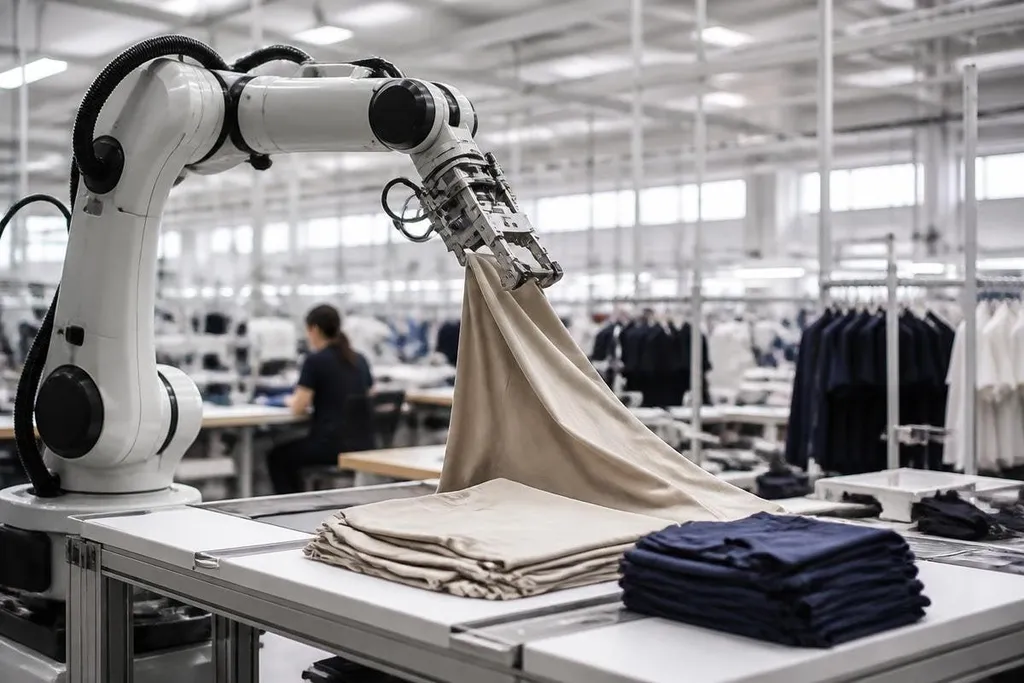
A shirt may pass through cutting, sewing, inspection, packing, and shipping before it reaches a store. Robots can now help with parts of that path, but cloth remains harder to handle than metal, plastic, or boxed goods.
The reason fashion robots matter is practical: makers need more control over labor, waste, quality, and production speed without treating every garment like a rigid machine part.
Quick read
- Robots fit best in repeatable tasks such as cutting, inspection, packing, and material movement.
- Soft fabric changes shape, so sewing and handling still need careful machine design.
- A useful system must prove its value on real garments, not only in a clean demonstration.
Where robots fit in fashion work
Fashion production has many small steps. A robot may move fabric between stations, place panels for cutting, inspect seams with cameras, or sort finished items by size and color.
These jobs share a useful trait: the task can be described clearly, repeated often, and checked against a known result. A camera can compare a seam with a set position. A gripper can move a stack of cut panels. A software system can record which batch passed inspection.
Material movement may be the easiest place to start. A material-moving robot that feeds a cutting table does not need to understand the full shape of a garment. It needs a known route, a safe stopping method, and enough accuracy to place each item correctly.
That still matters to a factory manager. Fewer manual handoffs can reduce waiting between stations and make production data easier to trace.
Why cloth is a hard material
Fabric bends, folds, stretches, and slips. Two pieces cut from the same roll may not sit in exactly the same position when a machine picks them up. A rigid gripper can crease the material or move several layers at once.
Sewing adds another problem. The robot must guide soft material while a needle moves through it. Small changes in tension can affect the seam, so the machine needs sensors, controlled motion, or a fixture that holds the fabric in place.
This is why a robot that handles boxes may need a different end effector for clothing. An end effector is the tool at the end of a robot arm, such as a gripper, suction pad, or sewing attachment.
The work also changes from one garment to another. A factory making one simple item in large batches has a clearer case for automation than a workshop switching between many designs, materials, and sizes.
The value goes beyond speed
Speed gets most of the attention, but repeatable work can help in other ways. During a task, the system can follow the same path, record faults, and keep working through a scheduled production period. That can make quality checks easier to compare across batches.
Waste is another reason to examine the technology. Better control during cutting and placement may reduce mistakes that send fabric to disposal. The amount saved depends on the material, the task, and how the factory measures waste.
Those savings need factory evidence before they can support a purchase. Robot24.com robotics coverage can connect fashion robots to real tasks, costs, and measured results, giving you facts to check against each site’s business case.
The business case still needs numbers from each site. A robot may save handling time but add costs for fixtures, software, training, maintenance, and changes to the production line.
A lower headcount is not the only measure, and it may not be the right one for every factory.
How to judge a fashion robot
Before buying or building a system, check the task rather than the robot’s general description. A useful review should answer these questions:
- Task fit: Can the robot handle the exact fabric, garment shape, and batch size used on the line?
- Changeover time: How long does it take to switch between styles, colors, or sizes?
- Error handling: What happens when fabric folds, slips, tears, or arrives in the wrong position?
- Line cost: Do the robot, fixtures, software, service, and staff training fit the planned savings?
- Human work: Which jobs remain, and what new skills will operators need to run and fix the system?
- Proof: Has the machine worked on the factory’s own material for a long enough trial?
I’d judge a fashion robot by its performance across ordinary production days, not by one clean cycle in a demonstration.
The next useful step is a narrow trial. Pick one repeated task, measure its error rate and handling time, then compare those results with the full cost of running it by hand. That is where fashion robotics moves from a promising idea to a buying decision.